AI App Design Tools Pricing 2026: Credits and Limits Compared
Compare free tiers, paid plans, credits and limits for Figma Make, Claude Design, Stitch, Uizard, v0, Lovable, Banani and Mowgli.
AI app design tool pricing: the short answer
Credits are not equivalent across AI app design tools. These eight products meter work through daily caps, monthly generations, model tokens, shared usage limits, variable message costs, fixed action prices or unlimited plans. Compare the usable output, reset rules and options after exhaustion, not the largest credit number.
Google Stitch is free with a daily limit. Figma Make Starter provides 500 AI credits per month, subject to a 150-credit daily cap. Claude Design shares Claude's rolling session and weekly limits. Uizard, v0, Lovable and Banani each define usage differently.
Mowgli provides 300 free credits and publishes a fixed price for each action. We make Mowgli.
The figures below come from vendor pricing pages, help centers and documentation. All amounts are in USD. Prices are from each vendor's pricing page, October 2026.
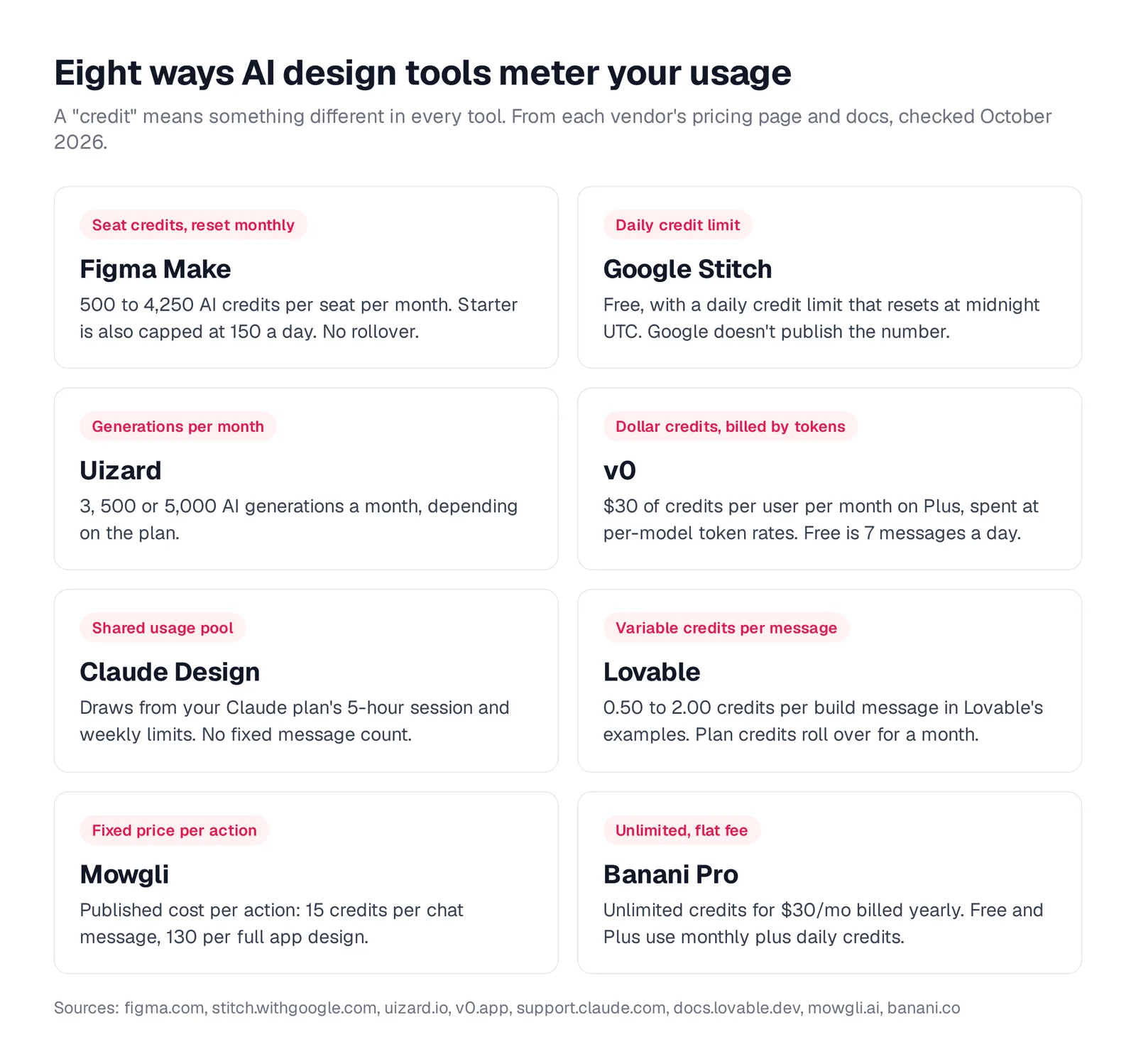
Caption: The eight metering models behind "credits". Original graphic based on vendor pricing pages and docs.
Quick picks by job
- Spend $0 on UI concepts: Google Stitch. It is free, with a daily limit that resets at midnight UTC.
- Stay inside Figma: Figma Make. A Professional Full seat includes 3,000 AI credits per month.
- Use an existing Claude subscription: Claude Design. It is included with Pro, Max, Team and Enterprise.
- Design a whole multi-screen app from a spec: Mowgli. It designs every screen and state, publishes action costs and hands the result to Claude Code, Codex, Cursor or another coding agent.
- Get unlimited generations for a flat fee: Banani Pro at $30 per month billed yearly.
- Build and host a working web app: Lovable or v0. Both use usage-based credits and include code and hosting workflows.
- Generate many simple wireframes on a small budget: Uizard Pro, with 500 AI generations per month for $12 per month billed yearly.
How to compare AI design-tool credits
Check five fields before choosing a plan:
- The free allowance.
- The lowest paid entry point.
- The work purchased by one unit.
- The rollover or reset rule.
- What you can do after exhausting the allowance.
A credit is simply a meter for AI work such as generating a screen, making a chat edit or exporting a design. It is not a standard unit.
One tool may charge a fixed amount per action. Another bills model tokens. Others vary the cost by complexity and context, impose daily caps, count monthly generations, share limits across an entire product or offer unlimited work for a flat fee.
A plan with 3,000 credits does not necessarily buy more design work than one with 100 credits.
Master comparison: free tiers, paid plans and limits
| Tool | Free allowance | Paid entry point | Unit and reset | At the limit |
|---|---|---|---|---|
| Figma Make | 150/day, up to 500/month | Professional Full: $16/month yearly or $20 monthly; 3,000/month | Cost varies by model, task and context; no rollover | Admin buys pooled credits or enables pay-as-you-go |
| Claude Design | Not on Free | Pro: $17/month yearly or $20 monthly | Shared Claude usage; rolling 5-hour and weekly limits | Wait, upgrade to Max or enable usage credits |
| Google Stitch | Free daily allowance | No paid plan listed | Count and per-generation cost unpublished; resets at midnight UTC | Wait for reset |
| Uizard | 3 generations/month; 2 projects | Pro: $12/month yearly; 500 generations/month | One AI generation; rollover not stated | Upgrade; Business includes 5,000/month |
| v0 | $5 one-time credits for new users; 7 messages/day | Plus: $30/user/month with $30 in credits | Per-model token rates; monthly credits expire after 65 days | Generation pauses; paid users can buy more |
| Lovable | 5 build credits/day, capped at 30/month | Pro: $25/month for 100 credits; $21/month yearly | Variable message cost; plan credits expire after 2 months | Building stops; Pro top-ups cost $15 per 50 credits |
| Banani | 12 credits/month plus 3/day | Plus: $12/month yearly or $20 monthly | A generation typically costs more than 1 credit; rollover not stated | Wait for refill or upgrade |
| Mowgli | 300 credits | Packs and monthly plans | Fixed published action prices; packs last 3 months and plan credits refresh each cycle | Buy a pack or choose a plan |
Figma Make pricing and AI credits
Figma Make is a prompt-to-app tool inside Figma. Its allowance is shared with other Figma AI features, including the Figma agent and Weave tools.
Starter includes 150 credits per day and up to 500 per month. Professional Full costs $16 per month billed yearly or $20 monthly and includes 3,000 credits. Organization Full costs $55 per month annually with 3,500 credits, while Enterprise Full costs $90 annually with 4,250. Dev and Collab seats receive 500 credits.
Figma's February 2026 examples put a font change at about 30 or more credits, making an attached design interactive at about 75 or more, and generating an app from scratch at about 100 or more. A five-screen mobile checkout flow made with the Figma agent costs about 300 or more.
The model, task complexity, context, chat history, attached files and libraries affect usage. Plan mode is billed separately from the build, and undo does not refund credits.
Credits reset monthly and do not roll over. Since October 6, 2026, the Figma agent and Weave tools have used the same budget as Make. Admins can purchase a pooled monthly subscription or enable pay-as-you-go with a spending limit. Add-on prices appear in the admin dashboard.
This fits teams already paying for Figma and creating prompt-driven prototypes inside Figma files. See Mowgli vs Figma Make for an output-focused comparison.
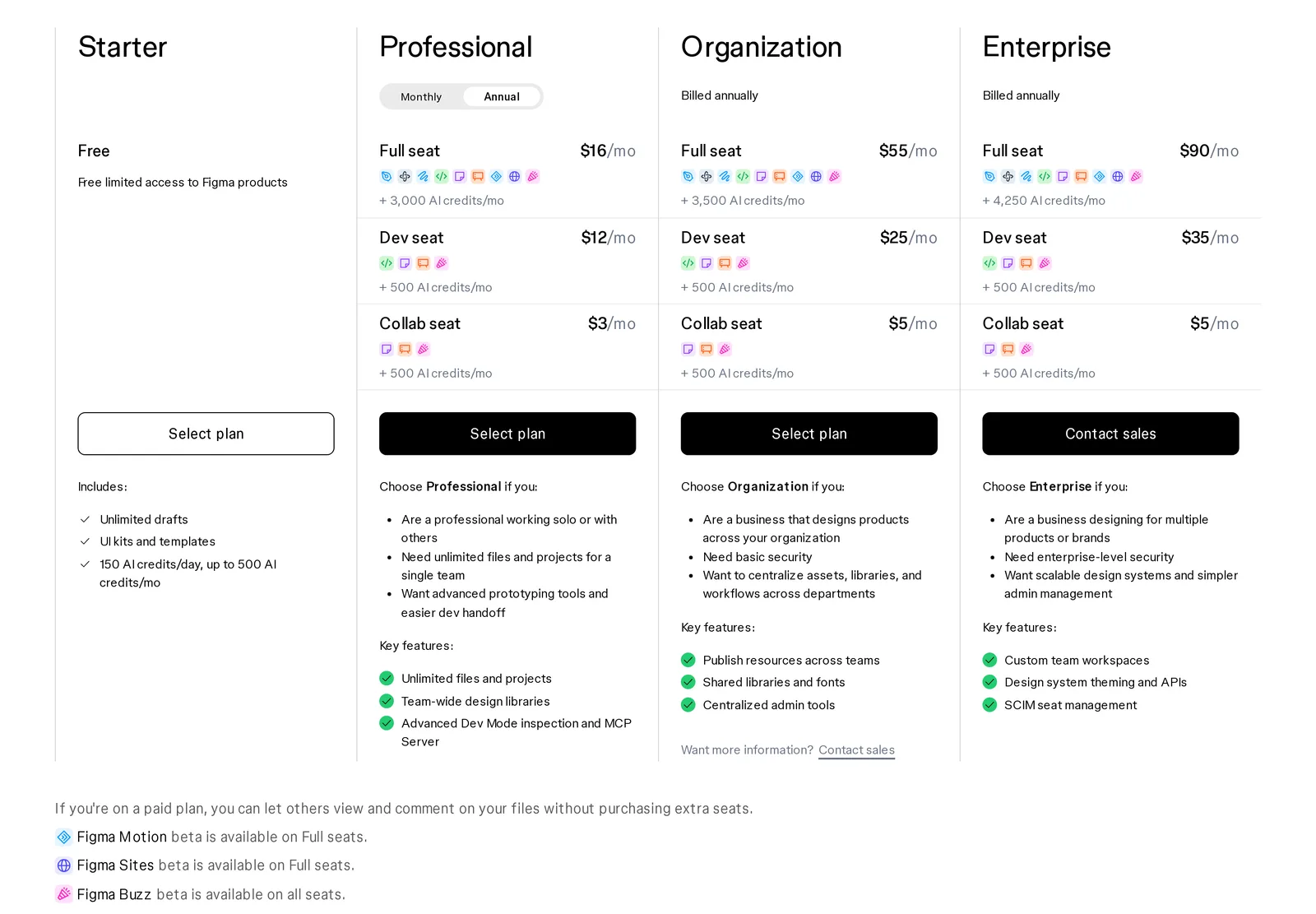
Caption: Figma's plans with AI credits per seat (annual billing, USD). Source: Figma website, captured October 2026.
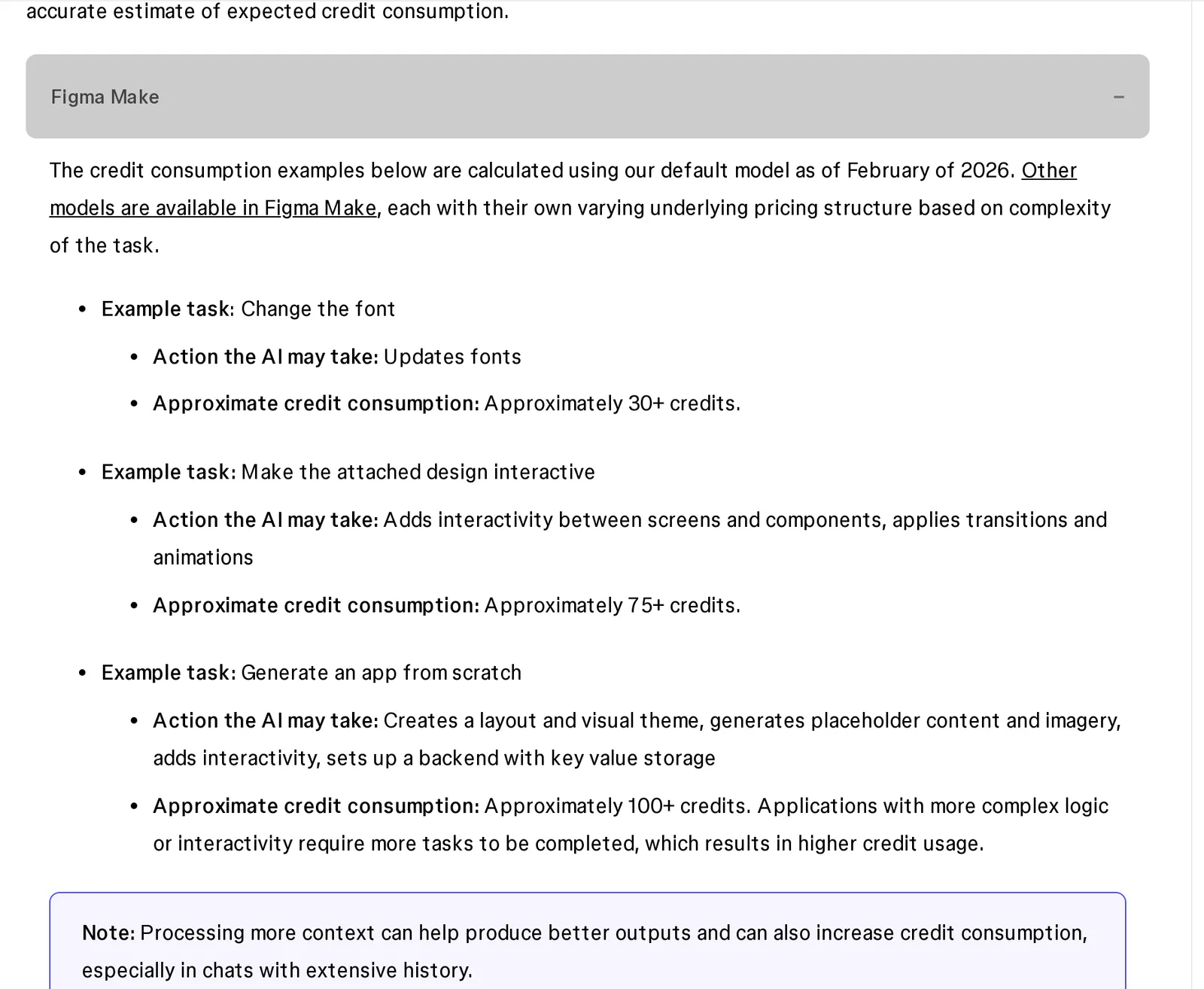
Caption: Figma's published Make credit examples. Source: Figma Help Center, captured October 2026.
Claude Design pricing and shared limits
Claude Design is Anthropic's beta design canvas for Claude conversations and Claude Code. It suits existing subscribers creating designs, decks and one-pagers beside chats and code.
Design is available on Pro, Max, Team and Enterprise, but not Free. Pro costs $17 per month when billed yearly at $200, or $20 monthly. Max starts at $100 per month.
There is no separate Design allowance. Work consumes the same pool as Claude chat and Claude Code, with a rolling five-hour session limit and a weekly limit on paid plans. Max provides 5x or 20x Pro usage per session.
Anthropic does not publish a fixed message count. Full decks and designs consume more of the limit than typical messages. After exhaustion, you can wait for a reset or use credits billed at standard API rates on paid plans. See the Claude Design alternatives.
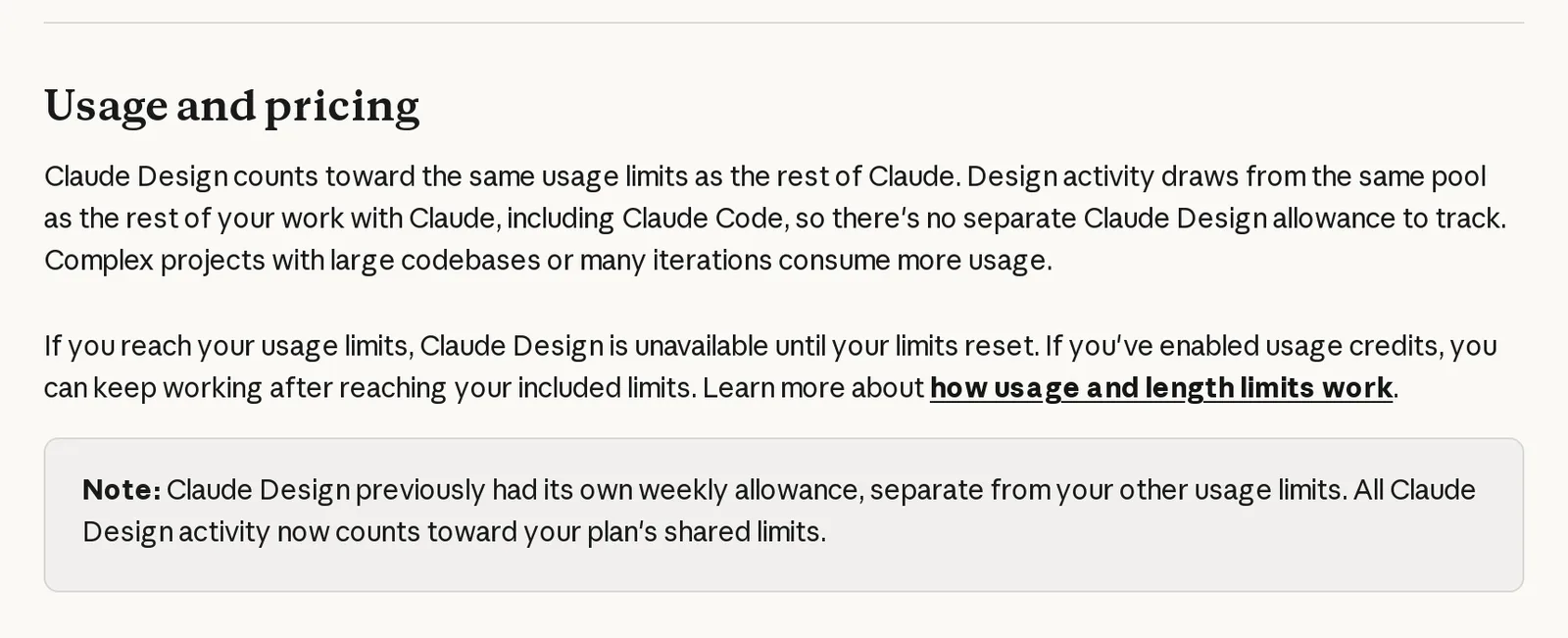
Caption: Claude Design's usage note. Source: Claude Help Center, captured October 2026.
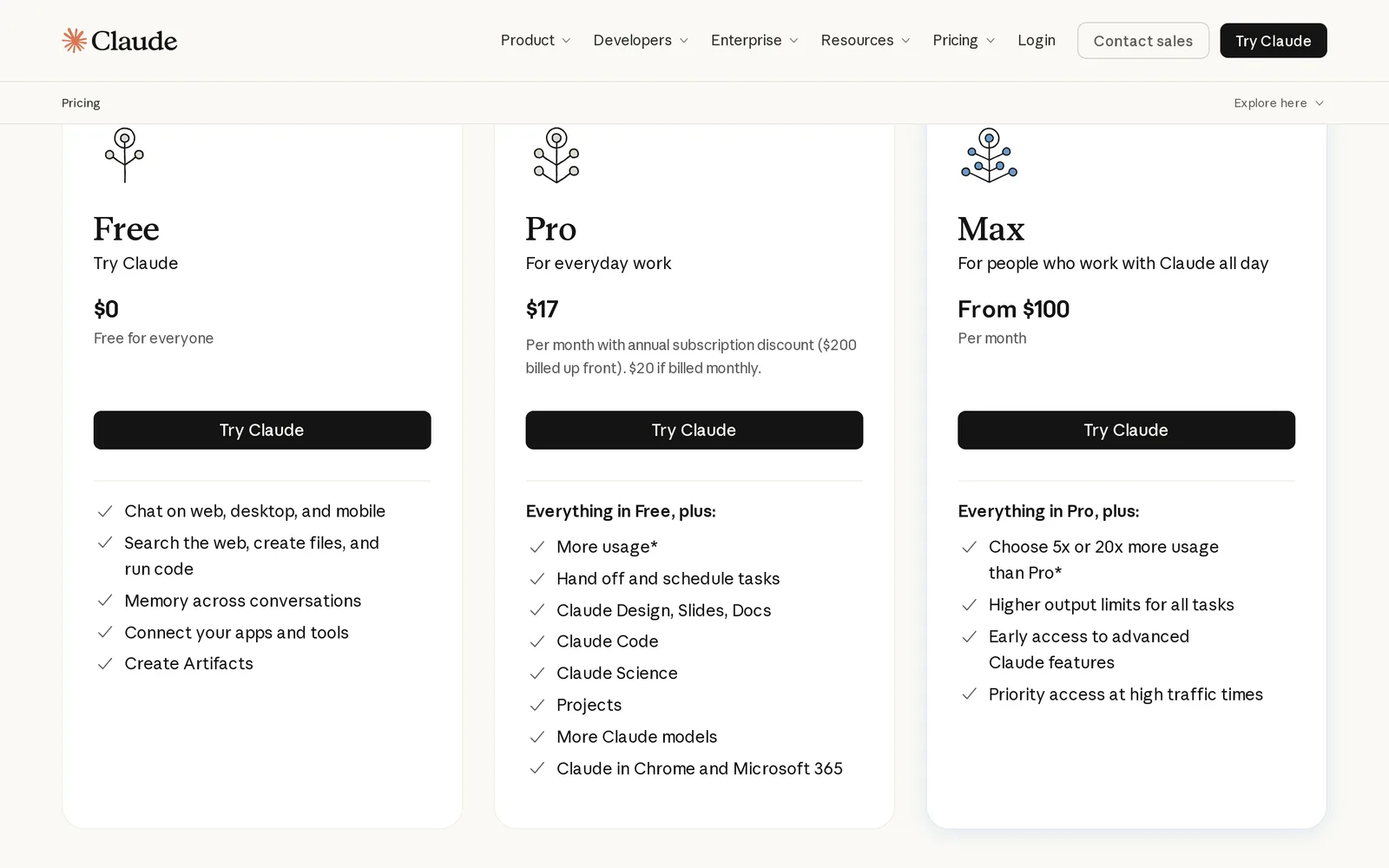
Caption: Claude's individual plans. Source: Claude website, captured October 2026.
Google Stitch pricing and daily limits
Google Stitch is a free Google Labs design canvas. It accepts prompts, sketches and screenshots, then produces editable UI, HTML/CSS and Figma output.
Stitch has a daily credit limit visible in settings. Google does not publish the allowance or the cost of a generation, and no paid tier is listed. Credits reset at midnight UTC, so reaching the limit means waiting.
Use it for free concepts and screen exploration. For connected product flows, read about Stitch for multi-screen apps or compare Mowgli and Google Stitch.
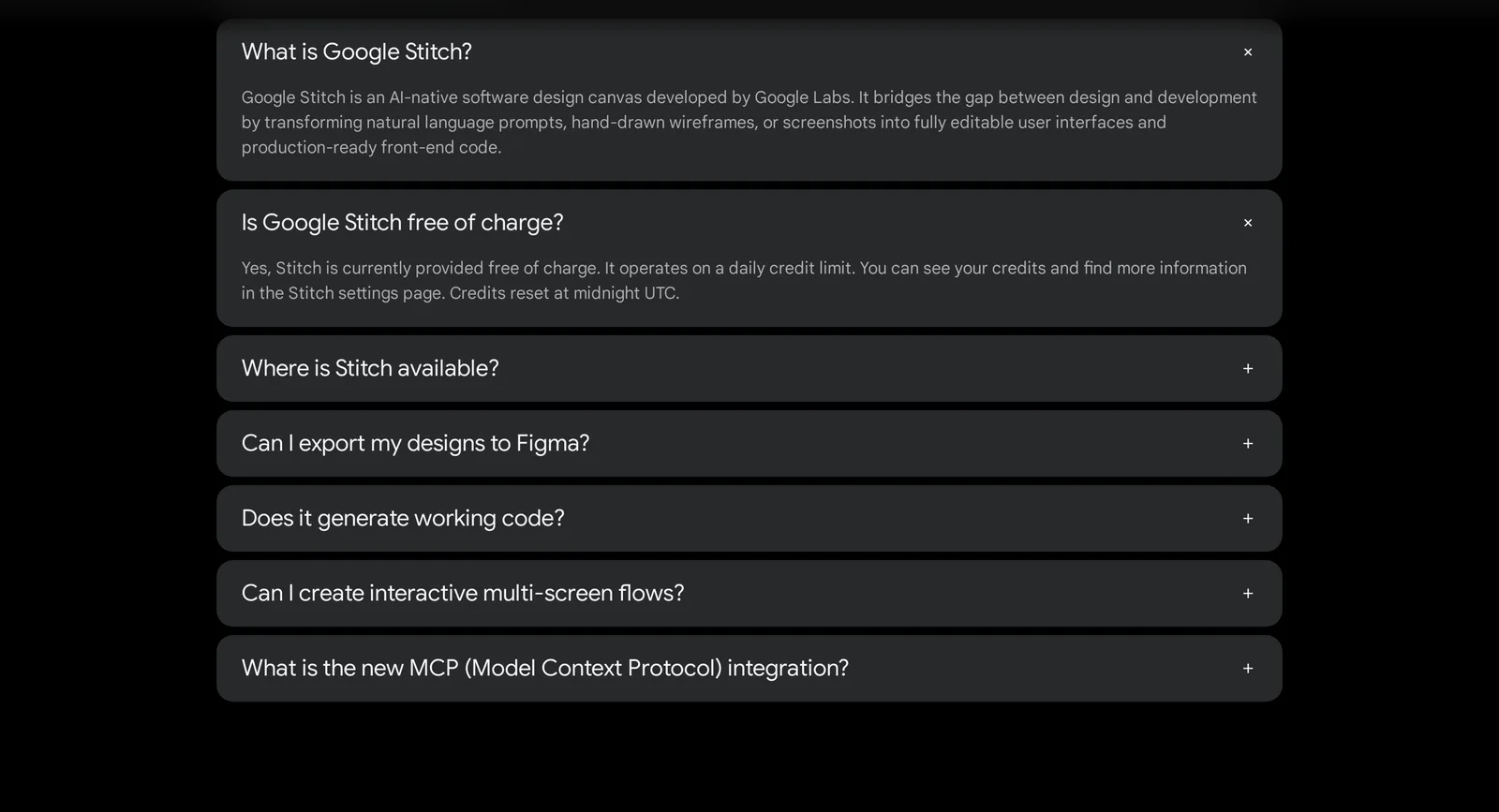
Caption: Stitch's FAQ on pricing. Source: Google Stitch website, captured October 2026.
Uizard pricing and monthly generations
Uizard is a drag-and-drop design tool with Autodesigner AI generation. It is part of Miro and fits non-designers making simple mockups and wireframes.
Free includes three AI generations per month, Autodesigner 1.5, two projects and up to five screens per project. Pro costs $12 per month billed annually or $19 monthly. It includes 500 generations, Autodesigner 2.0, React and CSS developer handoff, and up to 100 projects. Business costs $39 per month annually for 5,000 generations.
One generation can mean a project, screen or theme generated from text, a screenshot scan or a design review. No rollover or top-up option is listed. The free plan can hold two five-screen projects, so a 25-screen app requires Pro. Read more about Uizard in 2026.
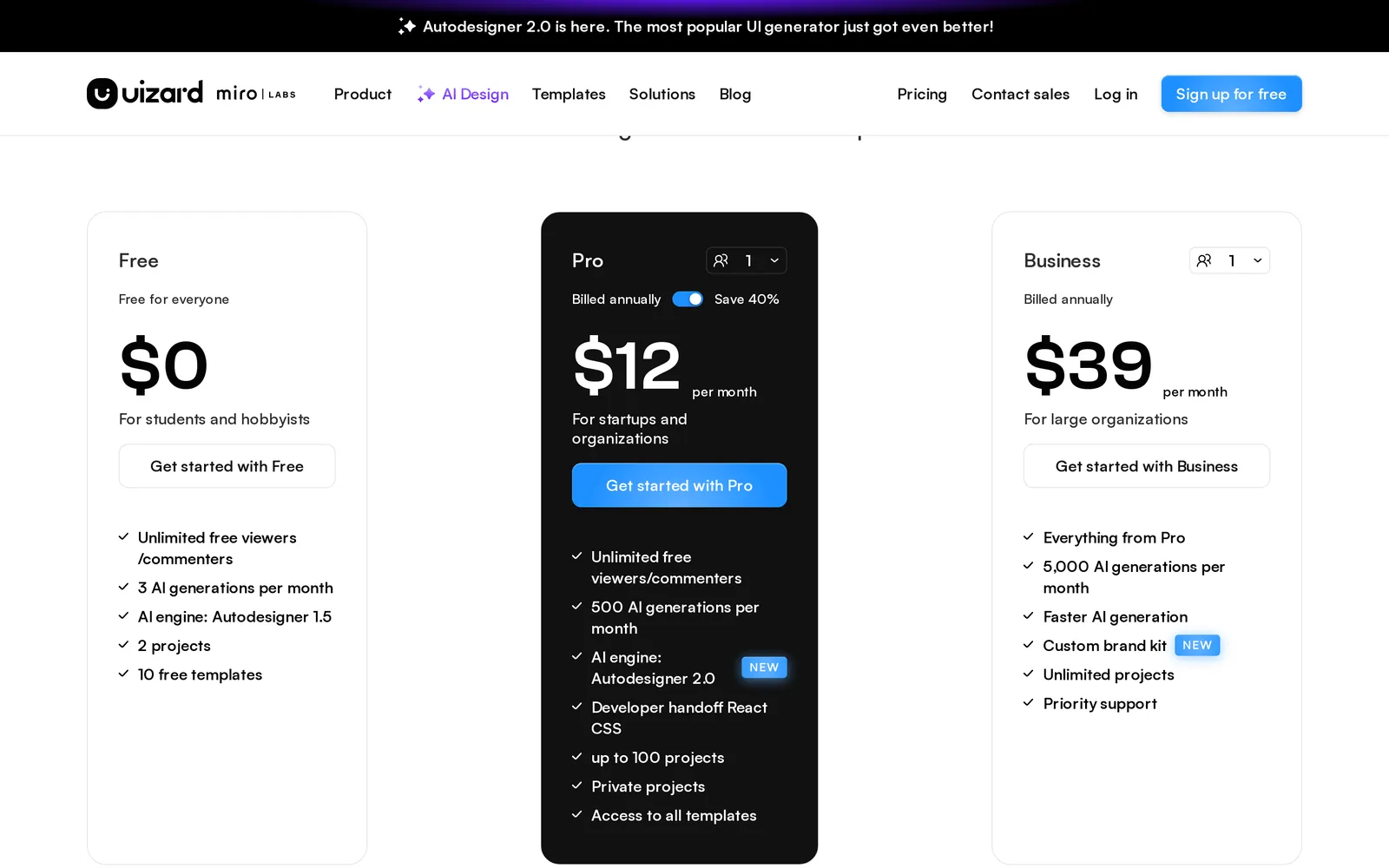
Caption: Uizard's plans. Source: Uizard website, captured October 2026.
v0 pricing and token-based credits
v0 is Vercel's prompt-to-web-app builder, with Vercel deployment and GitHub sync. It fits developers who need a deployable web app rather than design-only output.
Free provides $5 in one-time credits for new users and seven messages per day. Plus costs $30 per user per month, includes $30 in monthly credits and grants $2 in free daily credits on login. Business costs $100 per user per month.
Per million tokens, v0 Mini costs $0.20 for input and $1.20 for output. v0 Pro costs $2 and $10. v0 Max costs $5 and $25. Chat history and source files count as input, but tokens per screen are unpublished.
Monthly credits expire after 65 days. Generation pauses at exhaustion, and paid plans can buy more. Compare it with other builders in Lovable vs Bolt vs v0.
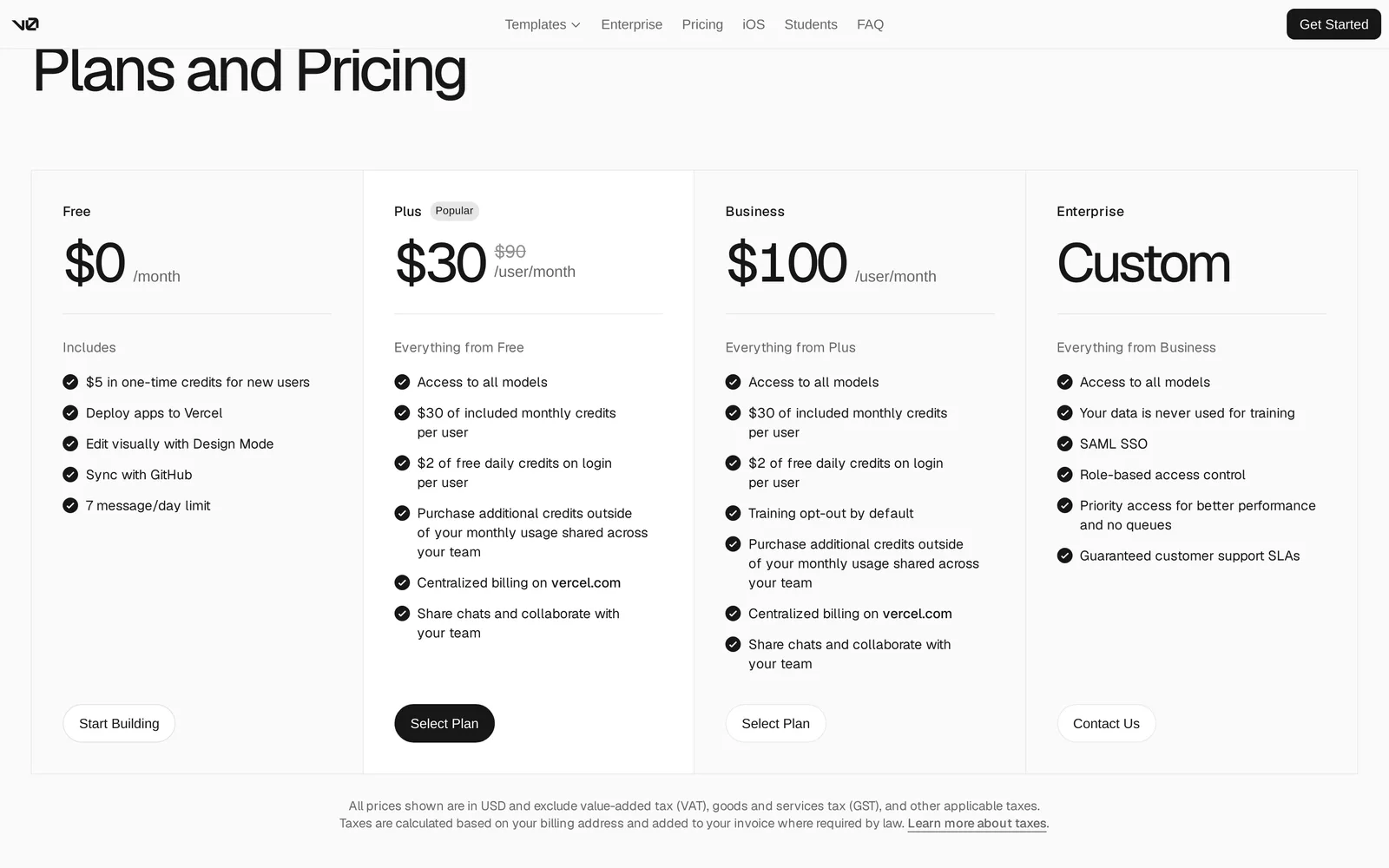
Caption: v0's plans. Source: v0 website, captured October 2026.
Lovable pricing, variable credits and rollover
Lovable builds and hosts web apps through chat, with Lovable Cloud for the backend. It fits founders seeking a working hosted app from a description.
Free provides five daily build credits, capped at 30 per month. Pro costs $25 monthly for 100 credits or $250 yearly, plus five daily build credits without a monthly cap. Business starts at $50 monthly for 100 credits.
Costs vary by message. Plan mode costs one credit. Published examples charge 0.50 credits to make a button gray, 1.20 to add authentication and 2.00 to build a landing page with images.
Credits also fund building, hosting, backend work and AI features in deployed apps. Monthly-plan credits remain valid for two months. When credits run out, building and credit-funded deployed features pause. Pro top-ups cost $15 per 50 credits; Free users cannot buy top-ups.
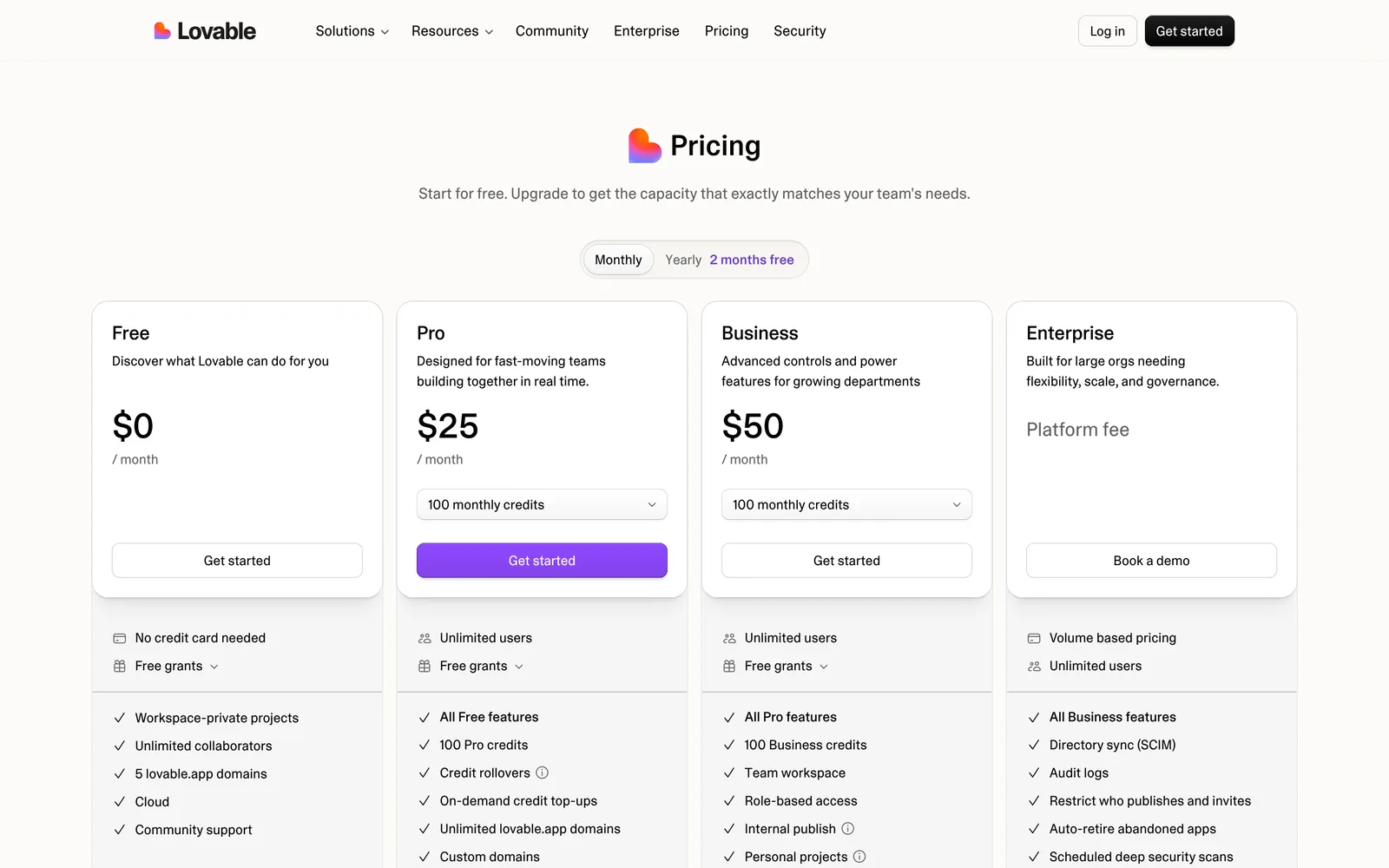
Caption: Lovable's plans at the 100-credit tier. Source: Lovable website, captured October 2026.
Banani pricing, daily credits and unlimited Pro
Banani generates UI screens and variations, supports Figma copy-paste and connects to coding agents through MCP.
Free includes 12 monthly credits plus three daily credits. Plus costs $12 per month yearly or $20 monthly, with 100 monthly credits plus 10 daily credits, agent mode, unlimited Figma export, MCP and code export. Pro provides unlimited credits for $30 per month yearly or $50 monthly. MCP is available on every plan, while Figma export requires a paid plan.
Banani says a generation "typically costs more than 1 credit, depending on the complexity of the task." Lower tiers must wait for a refill or upgrade; no top-up packs are listed. Pro is the clearest fit for many variations at a flat price. See Banani alternatives.
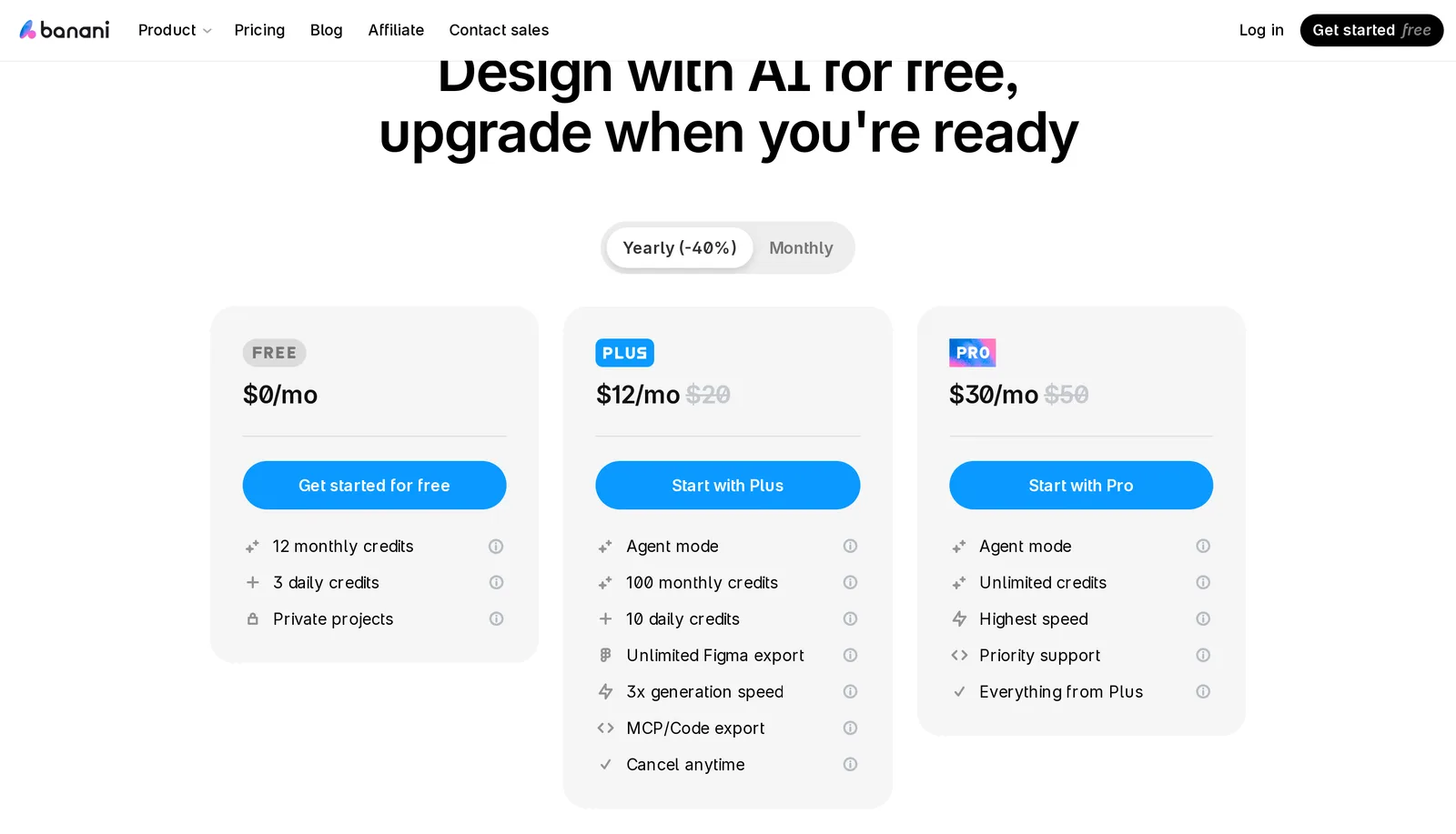
Caption: Banani's plans on yearly billing. Source: Banani website, captured October 2026.
Mowgli pricing for a complete multi-screen design
Mowgli turns a product idea into a full multi-screen app design: it writes the spec first, then designs every screen.
You complete a questionnaire, generate a PRD, explore themes, review every screen and state on an infinite canvas, make chat edits and create a clickable prototype. You can export to Figma or React + Tailwind, or hand the design to Claude Code, Codex, Cursor or another coding agent.
Free to start (300 credits); credit packs from $12; plans from $15/mo.
The free tier includes the questionnaire and PRD, a full wireframe app, Figma import, an MCP coding-agent connection and full version history. Packs cost $12 for 250 credits, $20 for 750, $40 for 2,000 or $100 for 8,000. They work with any feature and remain valid for three months.
Starter costs $15 monthly or $144 yearly, includes 500 monthly credits and covers about 30 messages. Pro costs $29 monthly or $240 yearly, includes 3,000 credits and covers about 200 messages. Team costs $59 per seat monthly or $588 per seat yearly, with 3,000 credits per seat and shared organization credits. Plans include free code and image exports.
Published costs are 50 credits to start a project, 30 for a questionnaire submission, 25 per theme preview, 130 to create the full design with every screen and state, and 15 per chat message. An agent edit costs 30 credits, or 10 on a plan. Figma export costs 10 per screen. A clickable prototype costs 250. Code and image exports cost 50 without a plan.
A PRD-to-wireframes walkthrough used about 240 credits for a project, questionnaire, spec, 10 wireframe screens and 40 states. A high-fidelity step-by-step run used about 1,200 credits for a spec, 23 screens, 77 states, theme previews, one chat edit and a 250-credit prototype.
You can buy a pack after exhaustion or choose a plan whose credits refresh each billing cycle. Mowgli designs and prototypes; to host and ship, you hand off to a builder or coding agent (Claude Code, Codex, Cursor, Lovable).
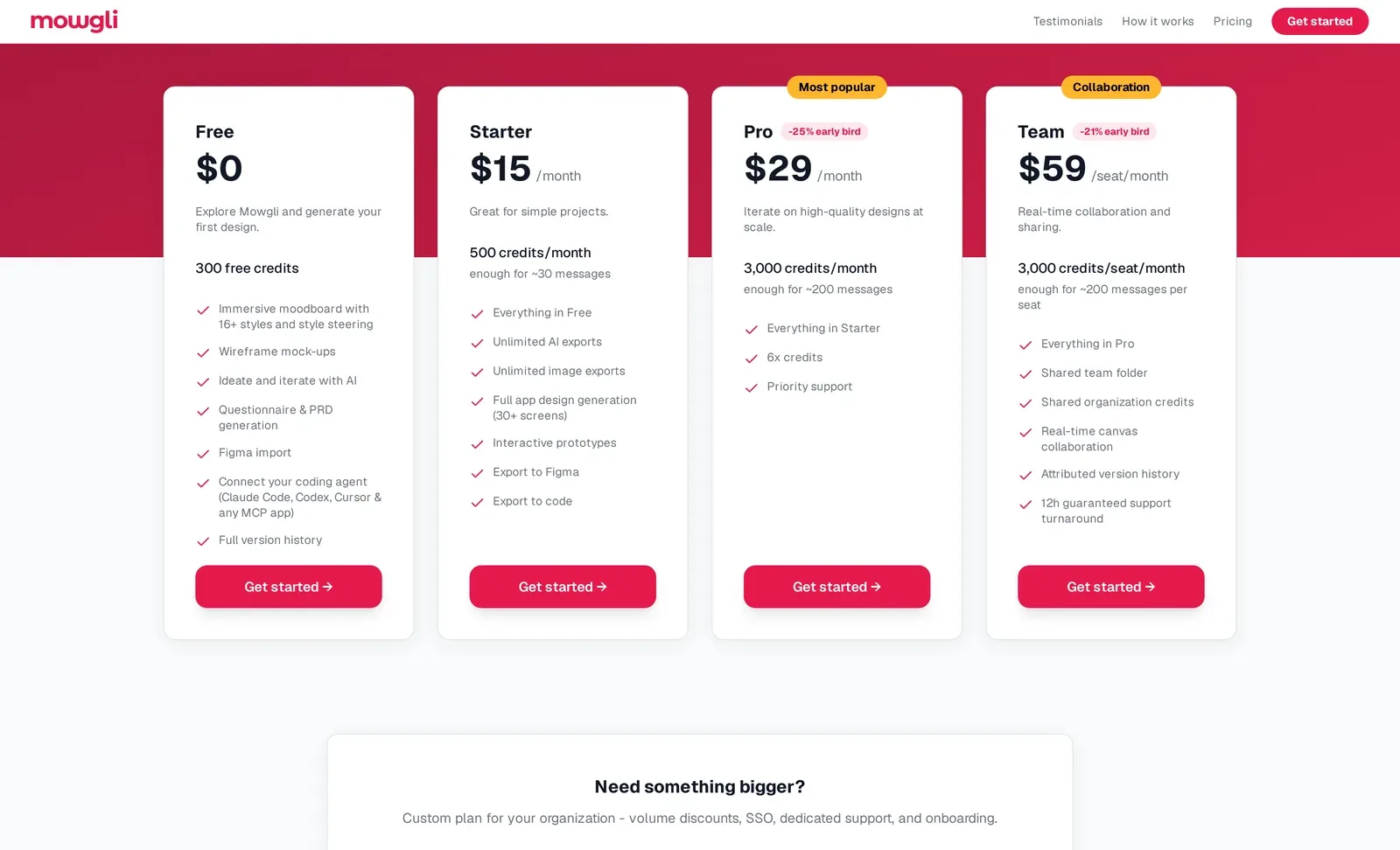
Caption: Mowgli's plans on monthly billing. Source: Mowgli website, captured October 2026.
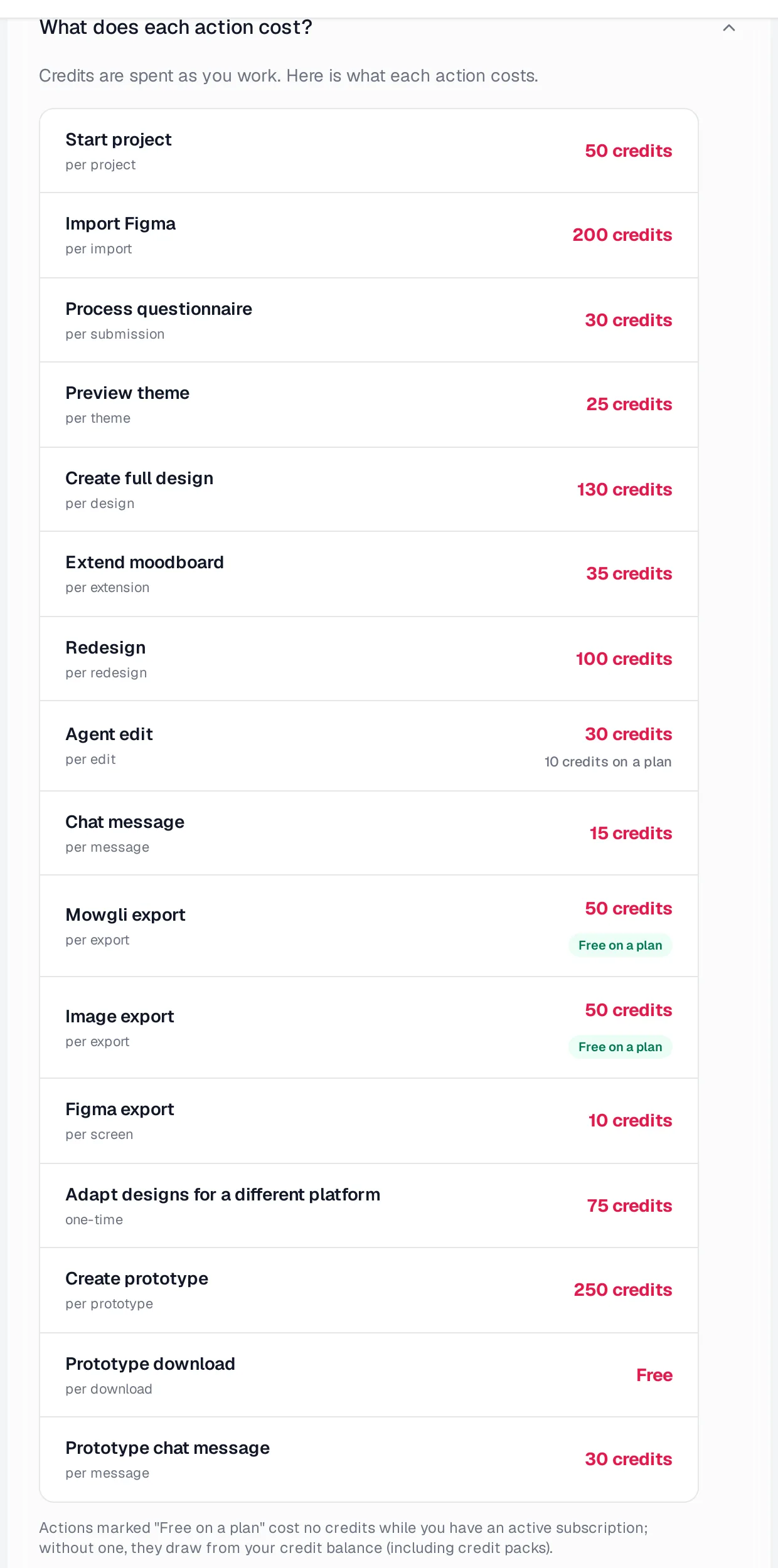
Caption: Mowgli's per-action credit costs. Source: Mowgli website, captured October 2026.
What does a 25-screen app cost?
Use only published examples or measured walkthroughs. If a vendor does not publish enough information, preserve the unknown instead of inventing a conversion.
| Tool | 25-screen scenario |
|---|---|
| Mowgli | A measured 23-screen, 77-state project with a prototype used about 1,200 credits. A $40 pack includes 2,000 credits; Pro includes 3,000 for $29 monthly. |
| Figma agent | Five published five-screen examples imply a 1,500-credit floor before edits. Professional Full includes 3,000 credits for $16-$20 monthly. That floor equals three Starter monthly allowances. |
| Figma Make | No defensible estimate. The 100-plus-credit app-from-scratch example has no screen count. |
| Lovable | About 60 credits: 25 x 2.00 plus 20 small edits x 0.50. This assumes each screen costs the same as the landing-page example; authentication and backend work may cost more. Pro includes 100 credits for $25. |
| Uizard | At worst, 25 generations plus retries if each generation creates one screen. Text-to-project generation may cover multiple screens. Pro includes 500 generations for $12 monthly billed yearly. |
| Banani | Pro is unlimited at $30 monthly billed yearly or $50 monthly. Published data cannot estimate Free or Plus. |
| Google Stitch | Free, but its unpublished daily limit prevents an estimate. |
| Claude Design | Pro costs $20 monthly or $17 monthly yearly, but there is no fixed message count. |
| v0 | Free allows seven messages per day, but tokens per screen are unpublished. |
For a broader budget breakdown, read how much it costs to design an app.
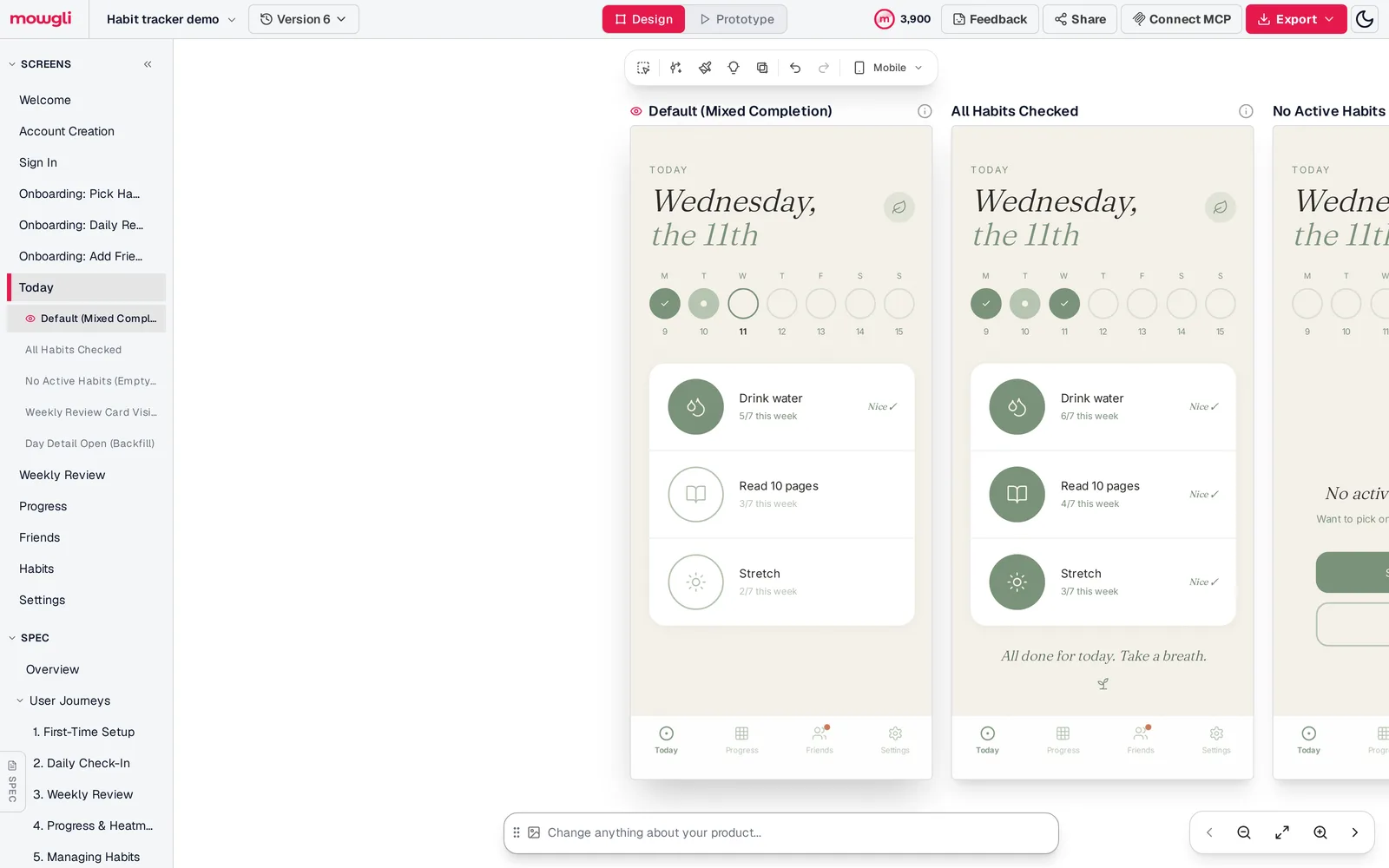
Caption: The Habit tracker demo in Mowgli: every generated screen in the sidebar, Today screen states side by side on the canvas. Mowgli app, captured October 2026.
How to spend fewer credits
Define the complete flow before generating. List required screens, empty states, errors, loading states, the data model and product constraints.
Approve the product design before spending Lovable, v0, Claude Code, Codex or Cursor credits on implementation. This reduces expensive build-stage revisions. See why you should design before you build.
Keep context intentional. Figma usage can rise with context, and v0 bills input tokens from chat history and source files.
Check reset, expiration and rollover rules before starting a large project. Daily free allowances work well for isolated concepts when waiting is acceptable. Fixed action prices make the budget easier to predict when you need a complete flow.
Claude Code, Codex, Cursor or another coding agent can read every screen and state through the Mowgli MCP server. You can also test the app screens generator.
Which pricing model fits your workflow?
Choose Google Stitch for short concept bursts when a daily reset is acceptable.
Choose Figma Make if your team already works in Figma. Check pooled-credit availability before a large project.
Choose Claude Design if you already subscribe to Claude and use little of the shared Claude Code and weekly allowance.
Choose Mowgli when you want a whole app designed from a spec, including every screen and state, with a budget based on published action costs.
Choose Lovable or v0 for a hosted working app. Lovable provides credit rollover; v0 uses token-based billing and Vercel deployment.
Choose Banani Pro for high-volume daily variations under an unlimited flat-fee plan. Choose Uizard Pro for simple wireframes with a large monthly generation allowance.
For a closer output comparison, read Figma Make vs Stitch vs Claude Design vs v0 vs Lovable.
Verdict
For a whole multi-screen product with predictable action costs, choose Mowgli. Its 300 free credits cover the measured wireframe workflow, and it designs every screen and state from a spec.
Choose Google Stitch for $0 concepts, Figma Make for Figma-native work, Lovable for a hosted app with credit rollover, and Banani Pro for unlimited UI variations.
The decision rule is simple: choose the output and reset or refill behavior you need, not the raw credit total.
FAQ
How much do AI app design tools cost in 2026?
AI app design tools range from free tiers to entry plans costing $12-$30 per month. Google Stitch is free, while Figma Make Starter, Uizard, v0, Lovable, Banani and Mowgli provide free access or allowances. Examples include Figma Professional Full at $16 per month yearly, Claude Pro at $20 monthly, Lovable Pro at $25 monthly and v0 Plus at $30 per user monthly.
Why do Figma Make credits run out so fast?
Figma Make credits can run out quickly because usage varies by model, task and context. Credits do not roll over, and undo does not refund them. Since October 6, 2026, the Figma agent and Weave tools have shared the Make budget. Published examples charge about 30 or more credits for a font change and about 100 or more for an app from scratch.
What are Claude Design's usage limits?
Claude Design has no separate allowance. It shares Claude's rolling five-hour session limit and the weekly paid-plan limit with Claude chat and Claude Code. Anthropic does not publish a fixed message count.
How many credits does it take to design an app?
The amount depends on the tool's meter and the app's scope. A Mowgli wireframe workflow fits within 300 free credits, while a measured 23-screen, 77-state design with a prototype used about 1,200. A Figma agent estimate for 25 screens starts at 1,500 credits, and the stated Lovable scenario uses about 60. Stitch, Claude Design and v0 do not publish enough data for a screen-based estimate.
What should I use when Figma Make credits run out?
Use Figma's admin add-on or pay-as-you-go credits if you want to remain in Figma. Google Stitch covers free concepts. Mowgli publishes fixed action prices, including 130 credits for every screen and state. Banani Pro offers unlimited credits for a flat fee.
Which AI design tool has unlimited credits?
Banani Pro has unlimited credits. It costs $30 per month billed yearly or $50 monthly. Lower tiers pause new generations until credits refill or you upgrade.
Sources
- Figma pricing
- Figma Make
- How Figma AI credits work
- Manage Figma AI credits
- Figma AI credit updates FAQ
- Figma AI credit updates
- Claude pricing
- Claude Design
- Get started with Claude Design
- Claude Pro plan
- Google Stitch
- Uizard pricing
- v0
- v0 pricing
- v0 pricing documentation
- Lovable
- Lovable pricing
- Lovable subscription plans
- Lovable credits and usage
- Banani
- Banani pricing
- Mowgli pricing